Blog

Article
What Is End-of-life and ...

What Is End-of-life and Failure Mode for an Ultracapacitor?

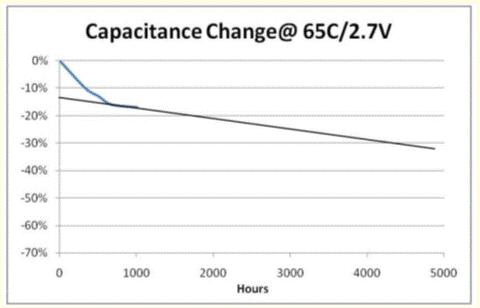
In general, ultracapacitors do not have a hard end-of-life failure as do batteries. Their end of life is defined as when the capacitance and/or ESR has degraded beyond the application’s needs.

Ultracapacitor failure can be caused by placing ultracapacitors in “abuse” conditions, which include over-voltage, over-temperature, and mechanical stress conditions. Over-voltage and over-temperature conditions can result in a loss of capacitance, increased ESR, bulging, and venting. Mechanical stress conditions can result in deformation, broken leads, and increased ESR.

Failure under Abuse Conditions

Other Recent Posts

What Is Equivalent Series Resistance (ESR)?

Equivalent series resistance (ESR) is a measurement of internal resistance in an energy-storage device and is specified in ohms (Ω). Internal resistance influences the flow of electrical energy through the device and...

Read post

Capacitor Selection Guide

Capacitors are widely used in electric circuits to store energy, suppress voltage spikes, and filter noise, ultimately enhancing a product’s performance. Although capacitors consist of...

Read post