Blog

Article
How Are Ultracapacitors Constructed?

How Are Ultracapacitors Constructed?

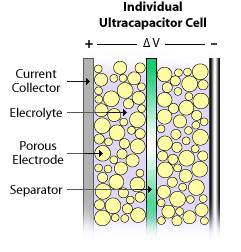
The specifics of ultracapacitor construction are dependent on the manufacturer and the intended application. The materials may also differ slightly between manufacturers or due to specific application requirements. The commonality among all ultracapacitors is that they consist of a positive electrode, a negative electrode, a separator between these two electrodes, and an electrolyte filling the porosities of the two electrodes and separators.

Internal Cell Construction

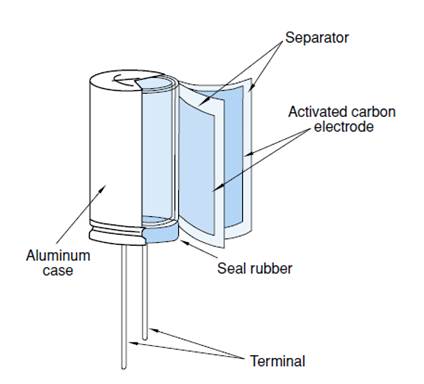
Most manufacturers have adopted a cylindrical construction method for their ultracapacitors; however, there are still products on the market that use a prismatic design. Tecate’s products use a cylindrical construction method. The cells are constructed from activated carbon particles, which are mixed with a binder and then deposited on aluminum foil. In this method, as shown in the following figure, the electrodes are wound into a jellyroll configuration very similar to an aluminum electrolytic capacitor. The electrodes have foil extensions that are then welded to the terminals to enable a current path to the outside of the capacitor.

External Cell Construction

Other Recent Posts

Tecate Group Announces New Ultracapacitor Cells Rated for Operation up to 105°C (221°F)

Tecate Adds to Its Already Extensive Product Lineup With New High-Temperature-Capable Ultracapacitors Cells San Diego, CA: June 1, 2026. Tecate Group today announced the expansion...

Read post

What Is Equivalent Series Resistance (ESR)?

Equivalent series resistance (ESR) is a measurement of internal resistance in an energy-storage device and is specified in ohms (Ω). Internal resistance influences the flow of electrical energy through the device and...

Read post