
Tecate Group capacitors and manufacturing solutions
Buy Ultracapacitors
 
ULTRACAPACITOR SOLUTIONS
New MCI Integration Kits! Find out more!
Download Ultracapacitor Design Tool
The power of the future. Today.


Tecate Group offers a broad range of ultracapacitors that include the Maxwell Boostcap® ultracapacitors, the CAP-XX low profile, low ESR super capacitors and  a wide range of standard and custom PowerBurst® ultracapacitor cells and modules, allowing designers to select the voltage and capacitance combinations that fit their applications.  With cell capacitance ranging from 90 Millifarad to 3,000 Farad, and custom packaging available, we can help you design a solution tailored to your needs.
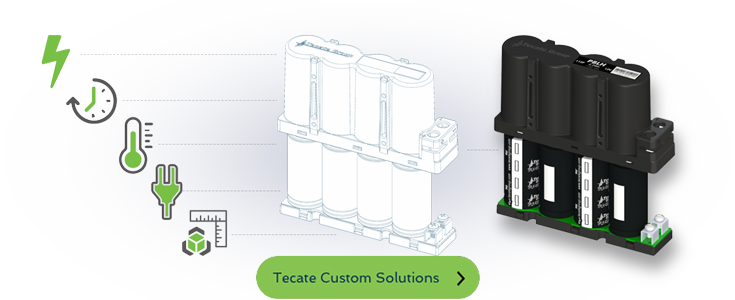
Custom ultracapacitor modules built by Tecate
Maxwell Boostcap Ultracapacitor cells and modules Cap-XX Supercapacitor cells and modules Tecate PowerBurst Ultracapacitor cells and modules
Ultracapacitor Integration Kits & Accessories

About Ultracapacitors

Ultracapacitors, also known as electro chemical double layer capacitors (EDLC) or super capacitors, differ from their chemical power storage counterparts in that ultracapacitors supply large bursts of energy and recharge quickly.

When a burst of energy is needed, the low internal resistance of the ultracapacitor delivers the needed current, whereas the higher resistance of the chemical battery causes the battery voltage to collapse. Ultracapacitors serve to eliminate the instantaneous energy demands placed on the battery and this in turn extends battery run time and prevents declining charge capacity as the battery ages. Ultracapacitors, unlike batteries, are maintenance-free and operate over a wide temperature range. Ultracapacitors used in conjunction with batteries or other power sources, like photovoltaic or fuel cell, provide an effective solution when batteries alone do not meet the performance objectives. Ultracapacitors are also an excellent choice for short term power back up required in seconds or minutes.

Portable applications and digital technology have outpaced chemical battery technology. A typical symptom of insufficient battery performance is the ratio of time the appliance is in use versus the appliance recharge time.
Another nuisance is when the battery has to be replaced prematurely as it will no longer hold a charge. In these situations, using batteries in conjunction with ultracapacitors can often improve overall system performance and extend battery life.

Ultracapacitors can be charged and discharged at the same rate. In a battery based approach the designer is limited to how fast the battery can accept the charge. Advantage ultracapacitors!

Ultracapacitors are not a new technology.  Ultracapacitors have been around for decades, and first appeared as a low power, low energy, and long life back-up for consumer electronic devices like VCRs.

During the last ten years there have been substantial advances in the material science as well as construction and manufacturing techniques, that have made ultracapacitors a desirable solution, especially in mission critical applications

Tecate Group is a significant supplier in the ultracapacitor market.  With a ever increasing number of ultracapacitor options, our customers are able to buy component level ultracapacitor cells ranging from 0.5F to 3000 F at 2.7V.  In addition to this wide array of ultracapacitor cells, Tecate offers modular solutions at various voltage and capacitance levels that include multiple packaging and interconnect schemes.  Tecate offers the full line of Maxwell Technologies and CAP-XX ultracapacitors as well as it’s own PowerBurst® brand of cells and modules. These cells and modules can be placed in series and/or parallel formats to satisfy different capacitance and voltage requirements.   These added value design and manufacturing capabilities allow Tecate Group to supply solutions tailored to our customers needs with very short turnaround times.

Based on existing technology, ultracapacitors possess high power and energy density compared with electrolytic capacitors. In recent years, these devices have found their way into consumer electronics, industrial and automotive applications.  Today, the best ultracapacitors are extremely high-power devices with power densities of up to 20kW/kg.  Compact in size (small-cell ultracapacitors are often the size of a postage stamp, or smaller),ultracapacitors can store much more energy than conventional capacitors and can release that energy quickly or slowly. They have long life and are designed to last the lifetime of the end product. 

In ultracapacitors, the electrode is based on carbon technology that allows for a large surface area. The combination of this surface area and a very small charge separation gives the ultracapacitors high energy density. Most ultracapacitors are rated in Farads and can typically be found in the 1-5kF range.  Depending on the application needed, ultracapacitors may be used as battery replacements or enable smaller, economical battery selection.  Ultracapacitors have low equivalent series resistance(ESR),allowing them to deliver and absorb high currents. The“mechanical” rather than chemical charge-carrier mechanisms enable long, predictable life with a smoother performance change over time. Applications benefiting from these characteristics include regenerative braking and other quick-charge scenarios such as in toys and tools.  Some applications are suited for battery/ultracapacitor systems.  Designs can be optimized to prevent battery over sizing for power demands. Examples include applications in consumer electronics such as digital cameras, in which an inexpensive alkaline battery is combined with an ultracapacitor rather than using expensive Li-ion batteries), and automotive applications such as hybrid power trains. 

An alternative to ultracapacitors is fuel-cell technology using proton exchange membrane(PEM), which is a high efficiency energy conversion device that can operate continuously for as long as hydrogen fuel is available. It is environmentally benign and can provide a reliable source of backup power for many applications. Since the amount of energy needed is limited, ultracapacitors are a better choice for most applications. Today, more fuel-cell companies are looking at the ultracapacitor as an integral component of their total package for backup power requirements.

Site Map | Contact | Search